
 Login
Login


The wild and obscure baru nut
In the EU, baru nuts are only authorised for sale since 2025. But what exactly are baru nuts? The short answer: Packed with protein, baru nuts play a key role in preserving a unique ecosystem.
The nuts grow across a vast area of two million square kilometres – large enough to accommodate the whole of Western Europe. Their home is the Cerrado region in Brazil, a sprawling savannah landscape with extraordinary biodiversity. The trees they grow on can reach heights of up to 25 metres.
"Even in Brazil, the baru nut is not widely known. There aren't many people in Rio and São Paulo who eat them. They're only available in speciality shops," says Rafael Avezum from our supplier Biodivér. The nut is virtually unheard of in Europe and is only authorised for sale since 2025.
What are baru nuts?
With their great taste and impressive nutritional profile, it’s surprising that baru nuts are still relatively unknown. They are members of the legume family, like peanuts. Compared to other nuts, such as walnuts or hazelnuts, they are richer in protein, lower in fat and higher in fibre.
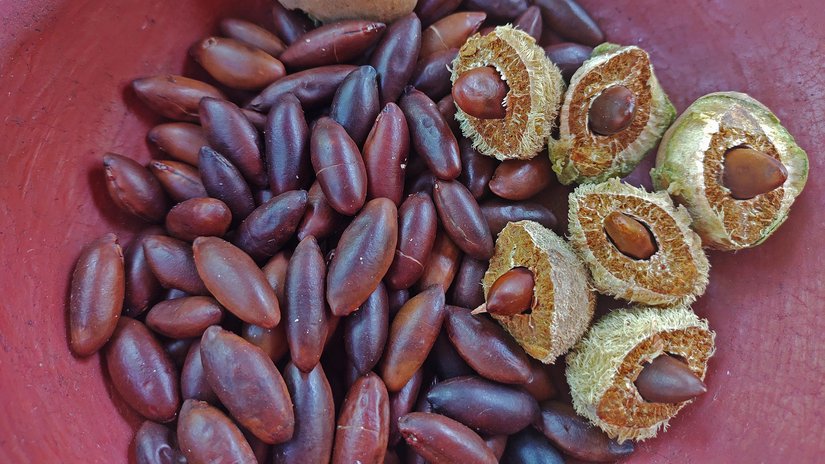
Baru nuts have a peanut-like aroma with notes of coffee and cocoa. They are encased in a thin, dark brown skin, which is also edible. "In Brazil, people usually just eat the roasted nuts as a snack," says Avezum. The nuts can be used in recipes in the same way as you would use almonds or peanuts. Coarsely chopped, they make a great topping for muesli and porridge. They can also be used for baking.
Who harvests gebana's baru nuts?
Baru nuts are always wild-harvested. "They can't be grown in monoculture. The trees rely on the Cerrado ecosystem to thrive and don't need extra irrigation. When the nuts are ripe, they fall to the forest floor and can be collected," says Avezum.
Biodivér works with 130 families who gather the nuts in five different regions of the Cerrado. "The harvest season lasts from July to November. For these families, it's a source of additional income. Some of them belong to indigenous communities, while others are people with low incomes who supplement their earnings by collecting the nuts."
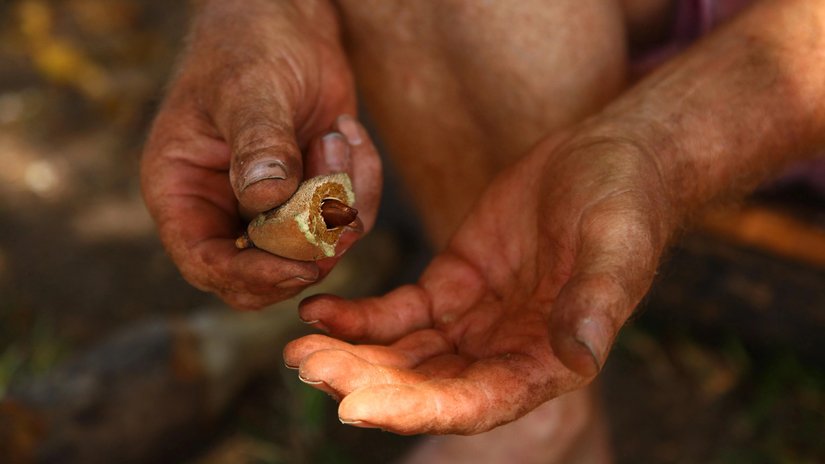
Baru nuts grow inside a thick, woody shell surrounded by pulp. The gatherers crack the shells open on the spot. Each fruit weighs up to 50 grams – much heavier than the edible nut, which weighs only 1 gram. They then take the nuts to Biodivér's regional collection points, and the company transports them to its processing plant in the Jussara region. Two Biodivér employees are in charge of processing. They sort and clean them before roasting them.
How do baru nuts contribute to preserving the ecosystem?
The unique ecosystem of the Cerrado is under pressure. Huge areas of land are being cleared for monocultures of soy or maize and for cattle farming. "People are slowly starting to change the way they think. Some of the bigger landowners leave the baru nut trees standing because they provide shade. Farm workers gather the nuts, which gives them some extra income."
When asked whether collecting baru nuts can harm the ecosystem, Avezum dismisses the idea. "The gatherers only collect undamaged nuts that are the right size. Furthermore, the gathering areas are so vast that it's impossible to collect all the nuts, even if they wanted to. The Cerrado region is very sparsely populated, so I don't see a danger of there being too many gatherers in any given place."
Why are baru nuts still relatively unknown?
According to Avezum, the demand for baru nuts still remains quite low, both in Brazil and in Europe. "I’d actually prefer it if the demand didn’t skyrocket. The açai berry is a good example of how something like this can backfire. It was marketed as a superfood and promoted by Oprah Winfrey, but its supply chain wasn't ready yet. It would be great if the market for baru nuts could grow more sustainably. Our plan is to develop our supply chain over the long term and gradually increase our delivery volumes." In addition to baru nuts, Biodivér sells other products from small-scale family farmers in the region, such as honey, mate tea and vegetable oil.
Biodivér baru nuts are available in the gebana online shop in 500-gram packs. They are gathered by 15 families in the Rio Vermelho region in the southeast of the Cerrado.